The meeting ends at 6:12. The body does not. The jaw stays tight, the shoulders stay high, and the breath sits somewhere near the collarbones. Even after the laptop closes, the nervous system is still answering a conversation that is already over.
This is not a failure of willpower. It is the body doing what bodies do: preparing for the next demand before the last one has fully passed. The question is not how to stop the response. It is how to help the system return.
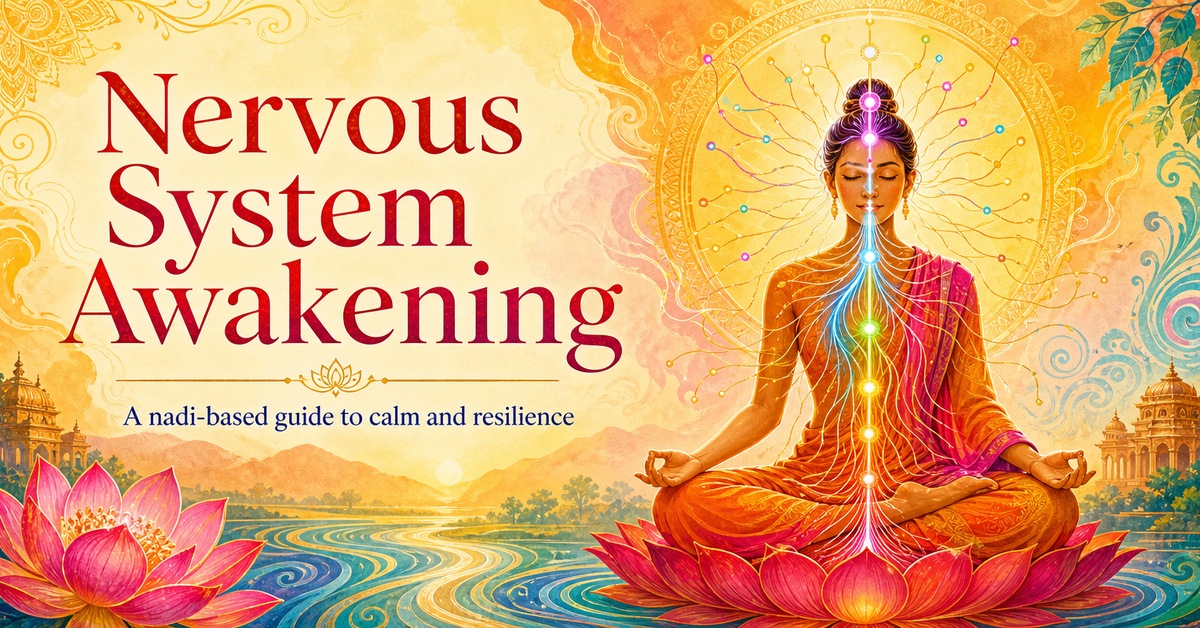
Yoga has a language for that return. In the Sri Amit Ray tradition, the body is threaded with 72,000 nadis — channels that carry prana — and 114 chakras that purify, regulate and distribute it. The nervous system is the physical layer of that map. When the breath settles, the channels feel open. When the mind is steady, the inner map becomes easier to read.
What nervous system regulation really means
Regulation is not a permanent state of calm. It is the capacity to move between activation and rest without getting stuck in either. A regulated nervous system can meet a deadline, hold a difficult conversation and then come down. It can feel excitement without tipping into anxiety, and rest without guilt.
The stress response is not the enemy. It is a wave of preparation: attention narrows, the heart speeds up, the muscles ready themselves. The problem begins when the wave has no shore to return to. The body stays braced, sleep becomes shallow, and ordinary decisions start to feel heavy.
Yogic practice approaches this gently. It does not ask you to force calm. It gives the body a rhythm it can trust: a slower breath, a softer jaw, a steadier posture, a moment of contact with the earth. The nervous system remembers how to return.
The nadis: a yogic language for the body
In the subtle-body model, prana moves through the nadis. Three are especially important in practice: ida, pingala and sushumna. Ida is associated with the cooling, receptive, lunar current; pingala with the warming, active, solar current; sushumna with the central channel that runs through the spine.
When ida and pingala are balanced, the body is neither overstimulated nor dull. Attention becomes clear, the breath becomes even, and sushumna — the central path — becomes easier to sense. This is the inner architecture behind many pranayama and meditation practices.
The 72,000 nadis feed the 114 chakras: 108 inside the body and 6 in the aura. The navel, heart and head are three of the most accessible centres for daily practice. The navel gives steadiness and vitality. The heart gives compassion and connection. The head gives attention and insight. A regulated nervous system makes all three easier to inhabit.
What research suggests
Modern research gives us a useful language for what practitioners have long described. The HPA axis — the body’s central stress-response system — coordinates cortisol, the autonomic nervous system and the return to baseline. In the Sri Amit Ray tradition, the HPA axis is discussed alongside the nadi and chakra map as one of the physiological doorways through which stress becomes embodied (Ray, “Neuroscience of the HPA Axis,” 2025).
Mindfulness-based interventions are associated with lower perceived stress in non-clinical adults; a 2026 systematic review and meta-analysis found consistent, moderate effects across programs (Rajan et al., 2026). Slow breathing has been linked to shifts in autonomic balance, heart-rate variability and subjective calm (Zaccaro et al., 2018). Even the brain’s oxygen consumption changes during meditation, suggesting that deep rest is not simply “doing nothing” (Ray, “Meditation and the Oxygen Consumption of the Brain,” 2017).
The research does not replace the tradition. It confirms what the tradition has always taught: the body is not a machine to be overridden. It is a living field that responds to rhythm, attention and care.
Why the breath comes first
The breath is the one part of the autonomic system that can be influenced at will. It is both voluntary and involuntary, a bridge between the mind and the body. When the breath changes, the nervous system listens.
In nadi practice, the breath is the vehicle of prana. Ida and pingala are balanced through the breath, and the sushumna opens when the breath becomes quiet. A slow, smooth exhale is especially useful: it signals safety to the body without requiring the mind to believe anything in particular.
Research on slow breathing has linked longer exhales to shifts in autonomic balance and heart-rate variability (Zaccaro et al., 2018). The key is rhythm, not force. Breathe in through the nose for four counts and out for six, keeping the exhale smooth. If you feel dizzy or uncomfortable, return to a natural breath. Two minutes is enough to change the tone of the next hour.
A five-minute nadi reset
This practice is short enough for the space between meetings and deep enough to change the tone of an afternoon. Sit comfortably, with the feet on the floor and the spine upright but not rigid.
- Settle. Let the jaw soften. Let the shoulders drop. Feel the weight of the body on the chair.
- Breathe. Let the breath be natural for a few rounds. Then lengthen the exhale slightly — in for four, out for six — without straining.
- Sense ida and pingala. Imagine a cool, receptive current on one side of the spine and a warm, active current on the other. Let them become even.
- Rest in sushumna. Bring attention to the centre of the spine. Imagine a quiet golden thread from the base to the crown. No force; just attention.
- Touch the heart. Place a hand on the chest. Recall one person or moment that makes kindness feel natural.
- Close. Return to the room. Take one ordinary breath and continue.
The practice works through repetition. Five minutes once is pleasant; five minutes most days becomes a relationship with your own nervous system.
Signs of progress
Progress is usually quiet. You may notice that you recover faster after a difficult conversation. Sleep may become deeper. The gap between a trigger and a reaction may widen by a few seconds. You may find it easier to say no without bracing, or to rest without needing to justify it.
These are signs of a system finding its shore. They are not a scorecard. The nervous system does not perform; it responds to safety, rhythm and consistency.
A practice for difficult days
Some days five minutes feels like too much. Use the ninety-second version instead:
- Place both feet on the floor and let the jaw soften.
- Take three slow exhales, longer than the inhales, without straining.
- Name one thing that is steady — the chair, the floor, the sound of the room — and let attention rest there.
The nervous system learns from repetition, not intensity. A short practice done on a hard day is worth more than a long practice postponed until the perfect morning.
Build recovery into ordinary life
The five-minute reset is a doorway, not the whole house. Recovery grows through small transitions: a slow walk after work, a few breaths before opening email, a moment of silence after a meal. The yogic tradition would call this sadhana — steady practice — but it is also simply good nervous-system hygiene.
Nature helps. Sound helps. Sleep helps. So does the company of people who do not require you to perform. The nadi map is not only for the meditation cushion; it is a way of noticing what opens the channels and what closes them.
Sound, touch and the return to the body
When the mind will not settle, the body can lead. Humming lengthens the exhale and vibrates the chest. A hand on the heart and a hand on the belly can bring attention back to the present. Warm water, bare feet on the floor and the weight of a blanket are simple forms of contact that the nervous system understands.
In the nadi view, sound and touch are forms of prana. Chanting, bhajan and kirtan use sound to gather the mind and open the heart; the same principle appears in the gentle repetition of a mantra. Research on music therapy and BDNF signaling, and on devotional chanting and movement, explores some of the physiological correlates of these practices (Ray, “Music Therapy and BDNF Signaling,” 2025; Ray, “Neuroscience of Devotional Bhajan Kirtan and Tai Chi Movements,” 2026).
These are not substitutes for practice; they are doorways into it. A hummed exhale, a hand on the heart, a moment of contact — each one gives the nervous system a small piece of evidence that it is safe to return.
A contemplative perspective
In the Sri Amit Ray tradition, nervous system regulation is not separate from spiritual life. The body is the first instrument of awakening. A steady breath, an open heart and a clear head are not luxuries added to practice; they are the conditions in which deeper practice becomes possible.
The 114 chakras give a larger map. The navel centre supports vitality and steadiness. The heart centre supports compassion and relationship. The head centres support attention and insight. When the nervous system is braced, these centres are harder to access. When it settles, they become available again.
The Ray 72000 Nadi System course and the Ray 114 Chakra System course explore this map in depth. The guide to the 72,000 nadis and 114 chakras is a good place to begin reading.
Final thoughts
The nervous system is not a switch to force; it is a relationship to restore. The nadi map gives that relationship a language: breath, attention, steadiness, and the quiet return to the body.
At the end of the day, ask three questions:
- Where did my body brace today, and what was it protecting?
- What helped me return — even a little?
- What is one small transition I can build into tomorrow?
Write the answers down. The nervous system listens to what we notice.
Frequently asked questions
Is regulation about staying calm all the time?
No. Regulation is flexibility: the ability to meet activation and return to rest. Calm is one part of the range, not the whole of it.
How long should I practice?
Five minutes most days is enough to begin. Consistency matters more than duration. Add time only when the shorter practice feels easy.
Can this replace professional care?
No. This is a contemplative practice, not a treatment. If you are working with trauma, anxiety or a medical condition, let it support — not replace — the care you receive.
References
- Rajan A., Kumar M., Pranav Raj P. Effects of mindfulness-based interventions on perceived stress among non-clinical adults: a systematic review and meta-analysis. npj Mental Health Research. 2026;5:9. https://doi.org/10.1038/s44184-026-00188-4
- Zaccaro A., Piarulli A., Laurino M., et al. How breath-control can change your life: a systematic review on psycho-physiological correlates of slow breathing. Frontiers in Human Neuroscience. 2018;12:353. https://doi.org/10.3389/fnhum.2018.00353
- Ray A. Neuroscience of the HPA Axis: 9 Primary Functions — A Scientific Review. Compassionate AI. 2025;4.12:69–71. https://amitray.com/neuroscience-of-the-hpa-axis/
- Ray A. Slow Breathing Yoga Pranayam to Reduce Oxidative Stress. Compassionate AI. 2024;1.3:15–17. https://amitray.com/slow-breathing-yoga-pranayam-to-reduce-oxidative-stress/
- Ray A. Meditation and the Oxygen Consumption of the Brain. Compassionate AI. 2017;4.12:21–23. https://amitray.com/meditation-and-oxygen-consumption-of-the-brain/