Creativity is not simply the arrival of a brilliant idea. It includes noticing a problem, exploring possibilities, combining information, testing an approach, and refining the result. Meditation is sometimes described as a way to unlock genius, but that promise is too broad. Research suggests that some forms of meditation may influence particular aspects of creative thinking under particular conditions. The useful question is not whether meditation makes everyone creative, but how attention practices can support the creative process.
Two modes of creative thinking
Divergent thinking generates multiple possible ideas; convergent thinking evaluates options and works toward a suitable solution. Both matter. A writer may need open exploration to find a theme and focused attention to edit a paragraph. A designer may brainstorm widely before selecting a workable prototype.
What studies suggest
A study by Colzato, Ozturk, and Hommel found that open-monitoring meditation was associated with improved divergent-thinking performance in their experimental setting, while focused-attention meditation did not produce the same pattern. A later meta-analytical review examined the broader relationship between mindfulness and creativity and highlighted the importance of moderators and differences between studies. These findings do not prove that meditation automatically increases artistic talent or workplace innovation.
A three-part creative meditation
Begin with five minutes of open awareness: notice sounds, sensations, and thoughts without following each one. Next, write ten possible responses to a creative question without judging them. Finally, choose one idea and work on it for a focused 20-minute session. The sequence alternates openness with evaluation, rather than treating them as competing skills.
Protect the conditions for original work
Creativity needs more than inspiration. It benefits from domain knowledge, time to experiment, constructive feedback, rest, and permission to make imperfect drafts. Reduce interruptions during deep work. Keep a notebook for questions and fragments. When using AI tools, treat outputs as prompts to interrogate rather than unquestioned answers. Your judgment, lived experience, and responsibility remain central.
Creativity as contemplative practice
In contemplative life, silence can create room to observe habitual reactions. For an artist or leader, this pause may help reveal assumptions and make alternative responses visible. The value is not mystical certainty; it is a more spacious relationship with attention.
A reflection practice
Choose one question you are working on. Spend five minutes in open awareness, ten minutes generating ideas, and twenty minutes developing one promising option. Record what changed in your thinking.
Ida, pingala and the creative field
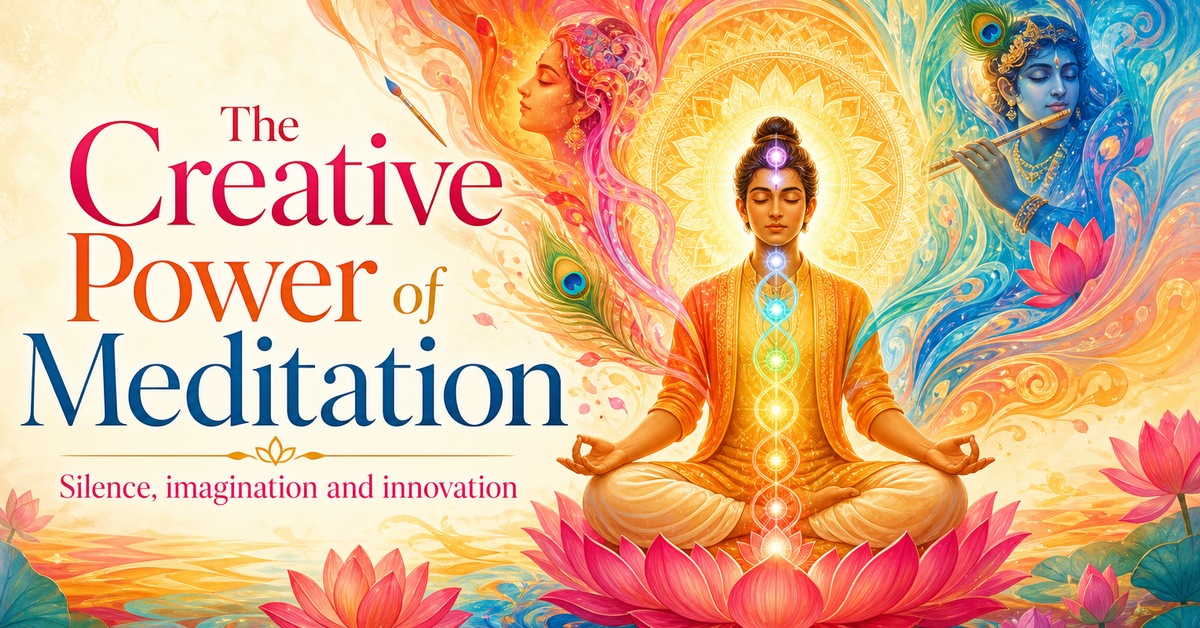
Creative work needs two currents. Ida is receptive, cool and inward — the space where images form. Pingala is active, warm and outward — the energy that brings the work into the world. When the two are balanced, inspiration has somewhere to land.
In the Sri Amit Ray tradition, the 72,000 nadis carry this creative prana, and the 114 chakras give it a field. The 114 chakras and the 72,000-nadi guide describe the inner architecture behind the flow state.
A creative meditation
Take ten minutes before creative work. Sit quietly and let the breath settle. Spend three minutes in Ida — receiving, listening, allowing images to arrive without judging them. Spend three minutes in Pingala — choosing one image and giving it form. Rest the last four minutes in Sushumna, the centre, where receptivity and action meet. Then write or make something immediately, while the field is still open.
The creative cycle: incubation, insight, execution
Creative work moves in a cycle. Incubation is receptive: you gather, listen and let the material settle. Insight is the moment of connection, when two ideas meet. Execution is active: you give the insight a form. Most creative blocks come from asking one phase to do the work of another.
Meditation supports the cycle by strengthening the receptive phase. It does not replace craft, and it does not guarantee a masterpiece. It gives the mind enough quiet for the next image to arrive.
A 7-day creativity reset
Day one: ten minutes of silence, then one page of free writing. Day two: walk without headphones. Day three: study one work you admire. Day four: make something bad on purpose. Day five: return to the free writing and circle one image. Day six: give the image a form. Day seven: share or shelve it, and rest.
The reset is not a productivity hack. It is a way of refilling the well.
For writers, artists and founders
Writers need silence before sentences. Artists need input before output. Founders need space between the problem and the decision. The same nadi practice adapts to each: a few minutes of slow breathing, a short period of receptive attention, then one concrete action. The action is part of the meditation.
When the well is dry
When nothing comes, stop forcing. Reduce input. Sleep. Walk. Return to a craft you love without trying to publish it. The Neuroscience of Samadhi and Sahasrara and the Default Mode Network are useful companions for the deeper states that support creative rest.
The 72,000-nadi guide gives the practice its larger map.
A five-day input/output rhythm
Creativity needs both receiving and making. Try this rhythm for one week.
- Monday — input. Read, watch or listen to one good work. Take notes.
- Tuesday — silence. Sit for ten minutes and let the input settle.
- Wednesday — make. Create something small and unfinished.
- Thursday — feedback. Show it to one trusted person and listen.
- Friday — finish. Give it a shape, even if it is imperfect.
At the end of the week, notice which phase you skipped. Most creative blocks are a missing phase, not a missing talent.
A practice for a fallow season
Every creative life has fallow seasons. The field is resting, not failing. When ideas are quiet, stop demanding output and protect the conditions for the next season.
Take one input walk without headphones. Read something outside your field. Make something small and private that no one will see. Sleep. The fallow season is not a gap in the work; it is part of the cycle that makes the next harvest possible.
At the end of the week, write one sentence about what you noticed. Do not turn it into a plan yet. Let the field rest a little longer.
A note on patience
The creative field does not respond to pressure in the way we hope. It responds to attention, input and rest. When the work is slow, the practice is to keep showing up without turning the slowness into a verdict about your talent. Patience is not passive; it is the active protection of the conditions in which the work can grow.
The work will wait for you; it rarely responds well to being rushed. Return tomorrow with a softer attention. That is enough. Begin again today.
Final thoughts
Creativity is not a factory. It is a relationship with attention, memory, risk and rest. Meditation supports that relationship by making room for the quiet phase where images form. The work still needs craft, feedback and finished pieces. The practice simply keeps the inner studio open.
The next time you feel blocked, ask which phase is missing: input, silence, making or finishing. Then give that phase ten minutes. The 72,000-nadi map is a reminder that the creative field is larger than the deadline.
Frequently asked questions
Which meditation is best for creativity?
There is no single proven best method. Open-monitoring practice has shown promising effects on divergent thinking in some research, but results depend on the task and context.
Can meditation replace creative skill-building?
No. Practice, knowledge, feedback, and revision remain essential.
Should I meditate before brainstorming?
You can experiment with a brief practice and track whether it helps your focus or idea generation.
Do I need to meditate to be creative?
No, but it helps. Many creators find that a short practice makes the receptive phase easier. The practice is a support, not a substitute for skill, feedback and finished work.
What if meditation makes me sleepy?
Change the posture. Sit upright, keep the eyes slightly open, or practise walking meditation. Sleepiness often means the body needs rest; if it persists, rest first and create later.
How do I fit creativity into a demanding job?
Protect twenty minutes, not a whole afternoon. Put it before the inbox. Keep a small project you can finish. Consistency builds more creative confidence than a rare long session.
What if I have no ideas?
Reduce output pressure and increase input: walk, read, listen, look at good work. The well refills through experience. The Neuroscience of Samadhi and Sahasrara and the Default Mode Network describe the deeper rest that supports insight.
References
- Colzato LS, Ozturk A, Hommel B. Meditate to create: the impact of focused-attention and open-monitoring training on convergent and divergent thinking. Frontiers in Psychology. 2012;3:116. https://doi.org/10.3389/fpsyg.2012.00116.
- Hughes Z, Ball LJ, Richardson C, Judge J. A meta-analytical review of the impact of mindfulness on creativity: framing current lines of research and defining moderator variables. Psychonomic Bulletin & Review. 2023;30(6):2155–2186. https://doi.org/10.3758/s13423-023-02327-w.