The journal is open. The candle is lit. The goal is written at the top of the page in careful handwriting. And then the familiar question arrives: What now?
Manifestation is often described as if the answer were hidden in the intensity of the wish. The yoga tradition takes a different view. It treats intention as a form of alignment — a way of bringing mind, breath and action into the same direction. The Sanskrit word sankalpa means a resolve, a vow, a heartfelt intention. It is not a spell. It is a commitment that the whole self can hear.
Psychology adds a useful language. Intention becomes powerful when it is specific, when it is contrasted with the obstacles in the way, and when it is tied to a concrete next step. The nervous system matters too: a body that feels unsafe has little room for vision. Manifestation, at its best, is the art of making intention feel possible in the body — and then acting on it.
What manifestation means in the tradition
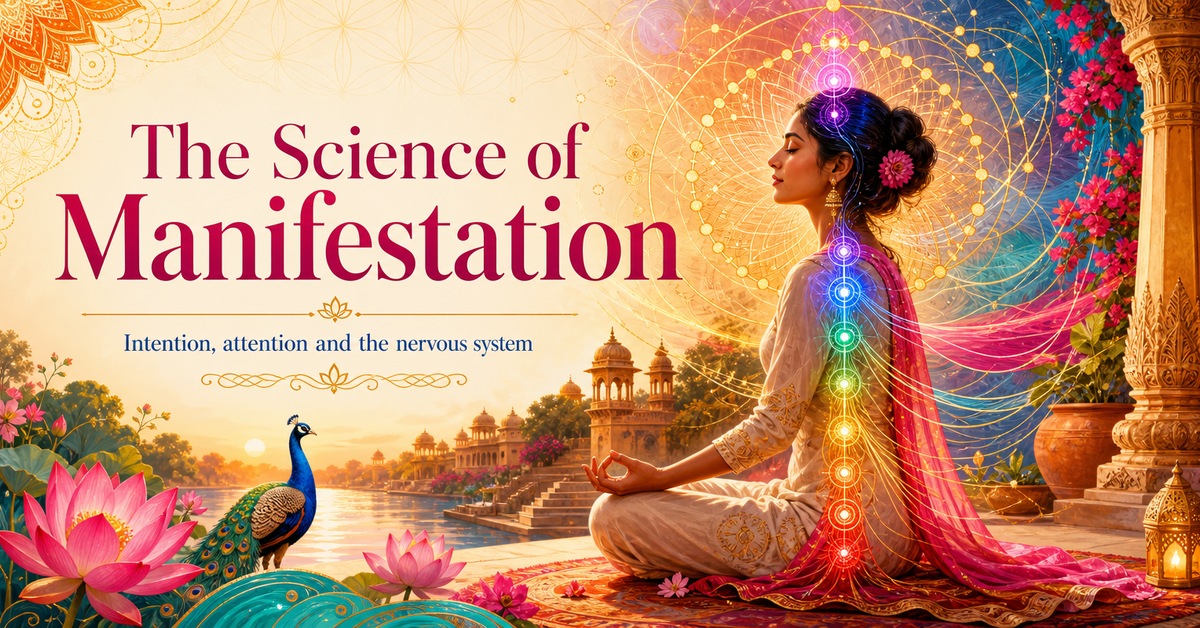
In the Sri Amit Ray tradition, intention is not separate from prana. The 72,000 nadis carry the vital current; the 114 chakras purify, regulate and distribute it. A sankalpa is planted in that field. The navel centre gives it steadiness, the heart gives it meaning, and the head gives it form.
This is why traditional practice often begins with the body. A quiet breath, a grounded posture and a calm heart make the intention feel like a place you can live from, rather than a demand you are making of the future. The Sri Vidya and mantra traditions work with sound, image and intention in precisely this way: the mantra is repeated until it becomes a shape of attention.
Manifestation, in this view, is not about attracting events from a distance. It is about becoming the kind of person who can meet the event. The intention changes the practitioner as much as it changes the world.
Sankalpa: the vow that includes the obstacle
A sankalpa is not a wish. It is a vow made in the presence of the whole self. In the tradition, the practitioner names what is true, names what is difficult, and chooses a direction anyway. The obstacle is not left outside the practice; it is included in the vow.
This is the difference between “I want this” and “I am willing to meet what stands between me and this.” The first stays in the mind. The second brings the navel, the heart and the head into the same conversation. The navel gives the vow weight. The heart gives it warmth. The head gives it shape.
Write the sankalpa in one sentence. Then write the obstacle in another. Then write the next action in a third. The three lines together are more powerful than a page of affirmation.
The psychology of intention
Research on goal pursuit offers a helpful bridge. Mental contrasting — imagining the desired outcome and then naming the obstacle — is associated with stronger goal commitment and better follow-through than positive fantasy alone (Wang, Wang & Gai, 2021). Implementation intentions — “when situation X arises, I will do Y” — turn a vague hope into a concrete cue (Ort & Fahr, 2022).
The Sri Amit Ray tradition describes a related mechanism through the reticular activating system, the brain’s attention filter: what we consistently name and rehearse becomes easier to notice and act on (Ray, “Reticular Activating System for Manifestation and Visualization,” 2021). A winning mindset, in this sense, is not arrogance. It is a trained orientation toward possibility, preparation and response (Ray, “The Neuroscience of a Winning Mindset,” 2023).
The practical implication is simple: give the intention a clear image, name the obstacle honestly, and attach it to an action you can take today.
The 114 chakras and the field of intention
The 114 chakras are not a checklist to complete. They are a field in which intention can be held. The navel centre gives stability. The heart centre gives compassion. The head centres give clarity and insight. A sankalpa held only in the head can become anxious; a sankalpa held in the whole field becomes liveable.
Try this: touch the navel and repeat the intention silently. Touch the heart and repeat it with kindness. Touch the forehead and repeat it as a clear direction. Then let the hands rest. The practice takes less than a minute, but it changes the way the intention sits in the body.
In the Sri Amit Ray tradition, the 72,000 nadis are the pathways that carry prana, and the 114 chakras are the centres that regulate and distribute it. The practice of manifestation is the practice of making the whole field coherent around a direction.
The nervous system is part of the practice
A vision that makes the body tense is not yet a usable intention. The HPA axis, the body’s stress-response system, shapes whether a goal feels like a challenge or a threat. When the breath is shallow and the shoulders are braced, the mind narrows. When the body settles, the imagination widens.
This is why the nadi practices matter. A few minutes of slow breathing, a softer jaw and a grounded posture can shift the internal weather enough for the intention to be held without panic. The practice is not about forcing belief. It is about creating a body in which belief is not fighting the nervous system.
In the Sri Amit Ray tradition, the 72,000 nadis and 114 chakras are a map of that inner weather. The navel gives the intention a base. The heart gives it warmth. The head gives it direction. When these three are aligned, action becomes more natural.
A four-step manifestation practice
- Clarify. Write the intention in one sentence, in the present tense, as if it is already a direction you are living. Keep it specific enough to act on.
- Contrast. Name the main obstacle — internal or external — without dramatising it. What usually gets in the way?
- Commit. Write one “if–then” plan: “If it is Tuesday at 9 a.m., I will write for twenty minutes.” Make the cue concrete.
- Act. Do the smallest version today. The nervous system learns from evidence, not from affirmation alone.
Repeat the four steps each morning for a week. The point is not to feel excited every day; it is to make the intention familiar enough to act on when motivation is ordinary.
Emotion, belief and ethical intention
Positive emotion can make effort feel more possible, but it is not a requirement. Difficult emotions do not mean the intention is wrong. They are information about what the practice is touching. The yogic path asks for honesty, not relentless positivity.
Ethics matter too. An intention that depends on controlling other people is not a sankalpa; it is a demand. The tradition’s emphasis on compassion and non-harm is a useful test: does this intention make room for others to flourish as well? If not, refine it until it does.
Manifestation without bypassing action
The most grounded form of manifestation is a loop: intention, attention, action, reflection. The intention gives direction. Attention notices what is changing. Action creates evidence. Reflection adjusts the next step.
This loop protects the practice from two extremes. It avoids the fantasy that thought alone is enough, and it avoids the cynicism that treats vision as pointless. The middle path is a living practice: hold the intention, meet the obstacle, take the step, learn, return.
Keep the practice small enough to repeat. A ten-minute morning ritual, done for three weeks, teaches the nervous system more than a weekend of intense visualisation. The intention grows through evidence, and evidence comes from action.
When the intention changes
Intentions are living things. A sankalpa that was true in January may need revision in June. That is not failure; it is feedback. The practice is to review the intention regularly, notice what has changed, and refine the next step.
The 114 chakras are a map of a living field, not a contract. The navel may ask for stability, the heart for connection, the head for a new direction. When the inner weather changes, the intention can change with it. Keep the direction; change the method.
A morning ritual for intention
Before the phone, before the news, take ten minutes with the journal. Light a candle if you like; the flame gives the attention a place to rest. Read the intention. Name the obstacle. Write the if–then plan. Then do one small thing before you leave the room.
The ritual is not a performance of positivity. It is a way of making the intention the first thing the nervous system meets in the morning, rather than the last thing it remembers at night.
A 21-day practice
Use the same short sequence each day:
- Minutes 1–2: Settle the breath. Feel the navel, the heart and the head.
- Minutes 3–5: Read the intention. Name the obstacle. Write the if–then plan.
- Minutes 6–10: Take one action, however small. Record what happened.
At the end of each week, review the evidence. What became easier? What needs a different approach? Keep the intention, change the method.
Final thoughts
Manifestation is not a substitute for action; it is a way of aligning intention, attention and action so that the next step becomes clear and livable.
Ask yourself:
- What do I actually want to become, not just receive?
- What obstacle have I been avoiding naming?
- What is the smallest action that would make the intention more real today?
Write the answers. The page is not magic; it is a mirror for attention.
Frequently asked questions
Does manifestation require a particular belief?
No. The practice works through intention, attention and action. Belief can help, but consistency and honest reflection matter more.
What if the outcome does not happen?
Revise the intention or the method. A missed outcome is information, not a verdict on your worth or your spiritual capacity.
How is this related to the 72,000 nadis?
The nadis are the tradition’s map of the inner field in which intention is held. The practice uses breath, attention and the 114 chakras to make that field steady enough for action.
References
- Wang G., Wang Y., Gai X. A meta-analysis of the effects of mental contrasting with implementation intentions on goal attainment. Frontiers in Psychology. 2021;12:565202. https://doi.org/10.3389/fpsyg.2021.565202
- Ort A., Fahr A. Mental contrasting with implementation intentions as a technique for media-mediated persuasive health communication. Health Psychology Review. 2022;16(4):602–621. https://doi.org/10.1080/17437199.2021.1988866
- Ray A. Reticular Activating System for Manifestation and Visualization and 114 Chakras. Compassionate AI. 2021;1.5:3–5. https://amitray.com/reticular-activating-system-for-manifestation/
- Ray A. The Neuroscience of a Winning Mindset: The Brain’s Blueprint for Success. Yoga and Ayurveda Research. 2023;15.1:45–49. https://amitray.com/the-neuroscience-of-a-winning-mindset-the-brains-blueprint-for-success/