Artificial intelligence can draft text, generate images, summarise documents, and help people explore unfamiliar ideas. These capabilities create opportunities, but they also raise questions about authorship, attention, trust, and the kind of human capacities we want to cultivate. Spirituality in the age of AI need not mean rejecting technology. It can mean using powerful tools deliberately while protecting reflection, responsibility, and human connection.
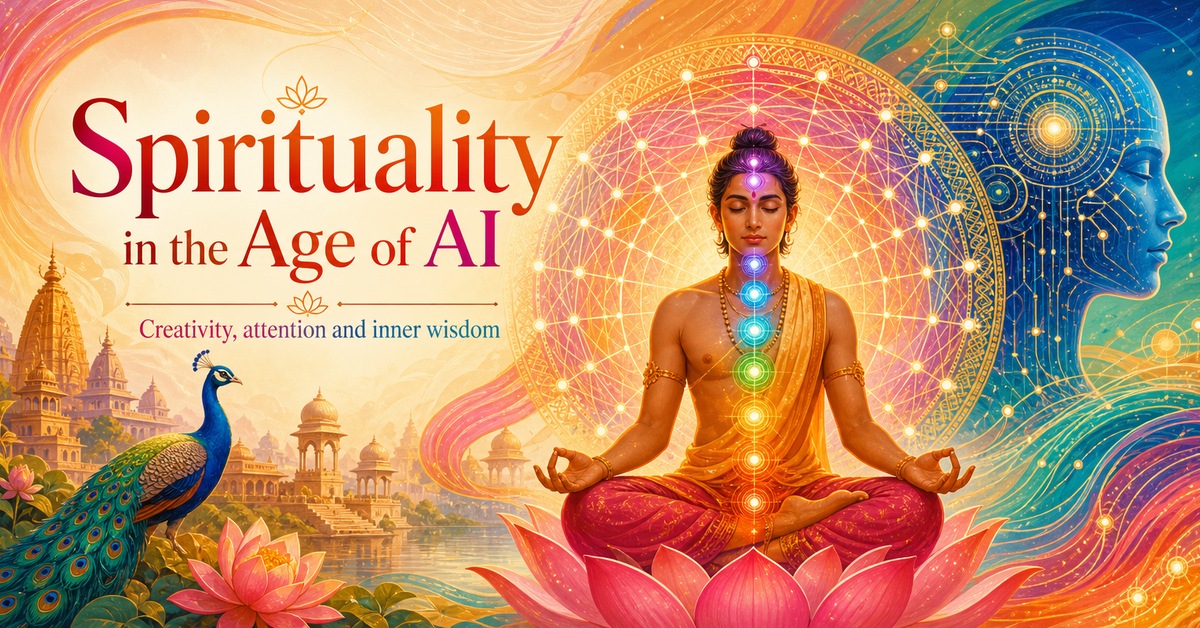
AI can assist creativity, but it does not remove human responsibility
Generative AI systems can produce novel combinations and useful starting points. Research on AI and creativity is still developing, and findings depend on the task, the definition of creativity, and how human participants use the tools. A systematic review of generative AI in creative contexts maps this emerging research area. A separate study in PNAS Nexus examined generative AI, human creativity, and art. Neither source justifies a simple claim that AI will replace human creativity.
Protect attention in a high-stimulation environment
Digital tools make it easy to switch tasks constantly. A 2026 scoping review of experimental research on digital media and attention found substantial variation in methods and outcomes; many studies examined immediate divided-attention costs rather than long-term changes. The careful conclusion is not that technology inevitably damages attention, but that interruptions and multitasking can interfere with the task at hand.
A mindful technology protocol
Before opening an AI tool, define the question you want to answer. Decide what kind of help you need: brainstorming, editing, summarising, or checking structure. Verify factual claims against reliable sources. Do not enter confidential personal or organisational information unless the tool and your policies permit it. Keep a record of decisions that require human review.
Use silence to strengthen judgment
A short pause before accepting an AI-generated answer can reveal missing context, bias, unsupported certainty, or ethical problems. Ask: What evidence supports this? Who might be affected? What is missing? Would I stand behind this decision if I had to explain it publicly? This is contemplative practice translated into digital responsibility.
Human wisdom is relational
Creativity and leadership are not only output production. They involve care, cultural understanding, accountability, embodied experience, and the ability to repair relationships. AI can support some tasks, but people remain responsible for how its outputs are used and for the consequences that follow.
A reflection practice
For one week, choose one daily 30-minute period for uninterrupted work. Use AI only after writing your own first question or initial idea. At the end, note whether the tool expanded, narrowed, or redirected your thinking.
Consciousness, compassion and AI
AI can generate language about spirituality with remarkable fluency. It can summarise the Upanishads, write a prayer or describe a meditation. What it cannot do is inhabit a body, feel compassion or sit with a question until it settles. The human advantage is not information; it is presence.
In the Sri Amit Ray tradition, the 72,000 nadis and 114 chakras are a map of that presence. The navel gives groundedness, the heart gives compassion, the head gives clarity. AI can support the work of the head; the rest remains a human practice. The AI consciousness and self-aware robots page, Can Quantum AI Become Conscious? and the Compassionate AI Architecture explore the frontier with care.
A mindful technology practice
Before opening an AI tool, name the task. After the tool answers, close the tab and take three breaths. Ask, “What did I learn, and what do I still need to think through myself?” Keep one decision per day entirely human: a conversation, a walk, a piece of writing. The practice protects the muscle that no model can exercise for you.
The attention economy and the inner life
Attention is the new currency, and it is also a form of prana. Every notification asks for a piece of it. Every feed trains the mind to move faster. In the yogic view, scattered attention is not a moral failure; it is a depletion of the inner field. The 72,000 nadis carry prana, and the 114 chakras regulate how that prana is used. When attention is constantly interrupted, the field feels thin.
The first spiritual practice in the age of AI is not a new technique. It is the recovery of undivided attention: one task, one conversation, one page, one breath.
AI as a mirror for consciousness
AI can produce fluent language about the self, but fluency is not experience. A model can describe samadhi; it cannot sit in silence. It can summarise compassion; it cannot feel the ache of another person. This distinction is not a rejection of AI. It is a clarification of what is human.
The AI consciousness and self-aware robots work and Can Quantum AI Become Conscious? explore the frontier honestly. The Sahasrara and the Default Mode Network essay adds a contemplative map of self-transcendence.
What to keep human
Keep judgment human. Keep apology human. Keep the moment before a hard decision human. Keep the walk, the ritual, the shared meal and the silence. These are not inefficiencies; they are the places where conscience and compassion are formed.
The compassionate AI question
The important question is not only “What can AI do?” but “What should it be allowed to do, and who answers when it causes harm?” The Compassionate AI Architecture treats care and non-harm as design requirements, not afterthoughts. That is a spiritual question as much as a technical one.
A five-day attention reset
Use this reset to recover the quality of your attention without rejecting technology.
- Monday — one screen. Do one task with every other tab closed.
- Tuesday — one silence. Take ten minutes without input: no music, no podcast, no feed.
- Wednesday — one conversation. Listen without preparing your reply.
- Thursday — one AI boundary. Use AI for a defined task, then close the tab.
- Friday — one human decision. Make a meaningful choice without asking a model.
At the end of the week, write what felt different. The practice is not anti-technology; it is pro-attention.
A practice for a distracted week
When attention feels shredded, do not try to fix the whole week. Choose one anchor and return to it.
Pick a single task that matters and give it twenty minutes with every notification off. Before you begin, take three slow breaths and name what you are about to do. When you finish, close the tab and stand up. The ritual matters: it teaches the nervous system that attention has a beginning and an end.
At the end of the day, write one sentence about what you actually thought. Not what you consumed — what you thought. That sentence is the beginning of a mind that is still your own.
Final thoughts
The age of AI does not ask you to reject the tools. It asks you to remember what the tools cannot do: sit with grief, feel wonder, keep a promise, forgive, or choose the harder right over the easier wrong. Those capacities are not obsolete. They are the point.
Attention is a sacred act. When you give it fully, you are not merely being productive; you are being present. The 72,000 nadis and 114 chakras are a map of that presence. AI can help you think; only you can be here.
Frequently asked questions
Does AI make people less creative?
The research is mixed and task-dependent. AI can assist ideation, but over-reliance may reduce independent exploration in some workflows. Evaluate its effect in your own context.
Can AI be spiritual?
AI can generate language about spirituality, but that does not establish that it has subjective experience, consciousness, or spiritual realisation.
How can I use AI mindfully?
Set a clear purpose, protect sensitive data, verify claims, disclose assistance when appropriate, and retain human accountability.
Will AI replace spiritual teachers?
No. AI can organise information, offer reminders and answer questions, but it cannot transmit presence, hold silence or see the student in front of it. The teacher’s role is relational, and relationship is not a language model.
Can AI support my meditation?
Yes, as a guide, timer, journal prompt or study companion. It is least useful when it becomes an authority on your inner life. Let it support the practice; do not outsource the practice to it.
How do I stop doomscrolling?
Change the environment before relying on willpower. Remove the app from the first screen, set one no-phone hour, and replace the habit with a breath or a short walk. The nervous system responds to cues more than to resolutions.
Is AI spiritually dangerous?
AI is a tool; the danger lies in how it is used. The useful question is ethical: does it serve attention, compassion and truth, or does it fragment them? The Compassionate AI Architecture offers a serious framework.
References
- Heigl R. Generative artificial intelligence in creative contexts: a systematic review and future research agenda. Management Review Quarterly. 2026;76:955–992. https://doi.org/10.1007/s11301-025-00494-9.
- Zhou E, Lee D. Generative artificial intelligence, human creativity, and art. PNAS Nexus. 2024;3(3):pgae052. https://doi.org/10.1093/pnasnexus/pgae052.
- Wiradhany W, Parry DA, Baumgartner SE, Nieuwenstein MR. Digital media and attention: a scoping review of experimental methods, theories, and evidence. Canadian Journal of Experimental Psychology. 2026. https://doi.org/10.1037/cep0000425.