Nyasa kriyas are central to yoga, worship and daily spiritual practice. Before the first lamp is lit in a traditional puja, the hand often moves before the voice. The thumb touches the index finger, then the middle, the ring, the little finger; a mantra is placed on each. The palm and the back of the hand follow. Only then does the practitioner reach for the lamp. This small sequence is Kara Nyasa, and it is one of the quiet hinges on which a larger ritual turns.
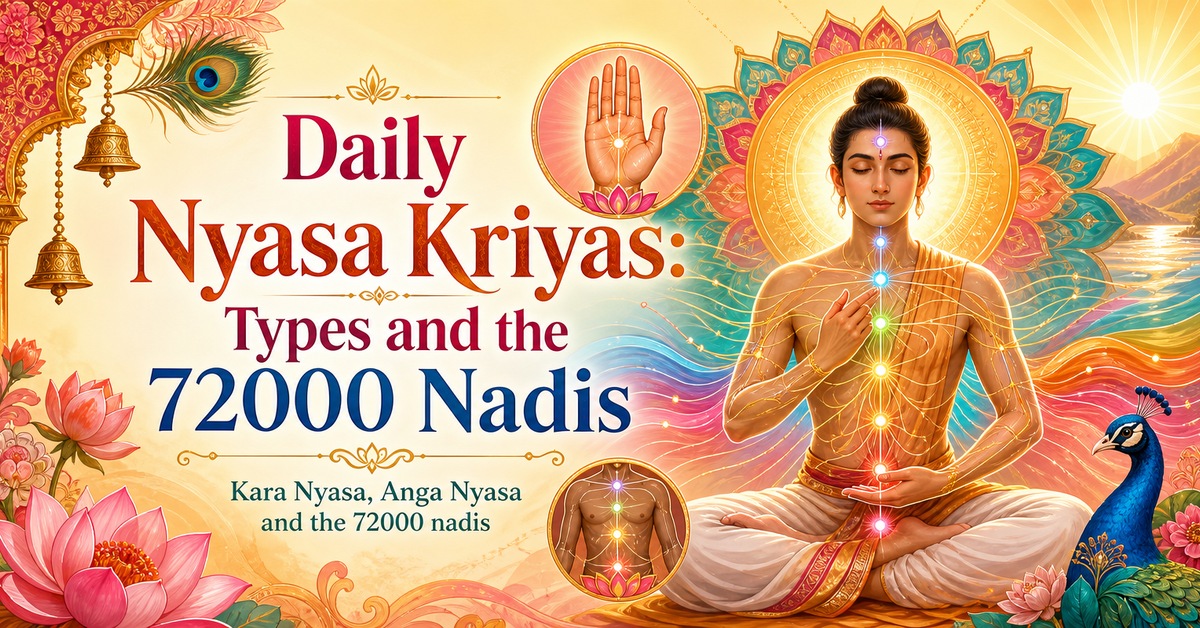
In the Sri Amit Ray tradition, Nyasa is linked to the 114 chakras and the 72000 nadis. It is central to Sri Rudram Sadhana, Sri Vidya Sadhana and any mantra sadhana, and it is used to build positive aura energy fields.
Nyasa means “placing” or “depositing”. In practice it is the ritual placement of mantra, letter or principle on the body, usually by touch, sometimes by gesture or intention. Its shortest daily form takes a few minutes; its longer forms belong to puja, initiation and tantric ritual. It is preparation: it makes the body ready, the hands fit for offering, and the mind gathered into one place.
Why practitioners use it
Nyasa appears at the beginning of worship, before mantra japa, at initiation, and as a daily practice of alignment. Its uses are practical as well as symbolic.
- To consecrate the hands. The hands will pour water, hold a lamp, offer flowers and count a mala. Kara Nyasa makes them fit for that work before the first visible offering.
- To install the mantra in the body. Anga Nyasa places the mantra on the heart, head and limbs. The deity is invited into the practitioner’s own frame, not merely remembered at a distance.
- To protect the body. The six-limb Shadanga Nyasa includes kavacha (armour) and astra (weapon). The body becomes a bounded, protected space for practice.
- To map the body as sacred space. Matrika Nyasa places the Sanskrit letters on the body; Tattva Nyasa places the principles. The practitioner locates the cosmos within, rather than only outside.
- To gather attention. Touch gives the mind a place to land. Before the first offering, the ritual has already begun.
In a temple, the image is bathed, dressed and offered food. In Nyasa, the practitioner does something similar with the body: it is prepared, marked and made ready for the deity. The outer ritual and the inner one mirror each other.
A short history: Veda, Upanishad, Purana, Tantra
The word nyasa belongs to the old vocabulary of Indian ritual: to place, to deposit, to entrust. Vedic ritual already knew the logic of placing a sacred utterance at a chosen point; the formal Kara and Anga sequences we know today were elaborated in the Tantric and Pancharatra ritual manuals, where the body becomes a map of the cosmos and the mantra becomes a presence to be installed.
The Upanishads give that map its inner geography. The Chandogya Upanishad (8.6.6) describes the hundred and one nadis of the heart and the one that leads upward; the same literature speaks of prana as the force that holds the body together. Nyasa later takes this inner geography seriously: the hand rests on a place, and the mantra names what is already there.
The Puranas bring the map into worship. The Bhagavata Purana (11.27) sets out the process of deity worship; the Devi Bhagavata Purana is a Shakta Purana with a strong Tantric current. The Lalita Sahasranama, one of the central texts of Sri Vidya, comes from the Brahmanda Purana. In these worlds, the deity is not an idea to be admired but a presence to be invited, installed and served.
Tantric traditions gathered these threads into precise ritual sequences. Vaishnava Pancharatra, Shaiva and Shakta Tantra, and Sri Vidya each developed their own orders. The six-limb Shadanga Nyasa became standard in many traditions; Matrika Nyasa, which places the Sanskrit alphabet on the body, belongs especially to Shakta and Tantric practice; Tattva Nyasa maps the principles of Samkhya or Tantra. The traditions do not agree on a single sequence; they agree that placement matters.
Nyasa in daily puja and the deity traditions
In a daily puja, Nyasa often comes after the invocation and before the offerings. The practitioner invites the deity, places the mantra in the hands and body, and only then offers water, flowers, incense and light. The sequence differs by tradition: a Smarta household, a Vaishnava temple and a Shakta practitioner will not use the same order, and each deity has its own mantras and placements.
Ganesha and the guru are often invoked first, so the path is clear and the practice is well founded. Shiva, Vishnu and the Devi each have their own Nyasa traditions. In Shakta practice the goddess may be installed in the body as the Sri Chakra; in Vaishnava Pancharatra the mantra of Vishnu or Narayana is placed on the limbs; in Shaiva practice the mantra of Shiva is placed on the heart and head. The details vary by tradition and teacher, and that is the point: Nyasa is a living practice, not a generic technique.
Sri Vidya: placement at its most elaborate
Sri Vidya is the Shakta tradition of Lalita Tripurasundari and the Sri Chakra. Its ritual life is built on Nyasa. Kara and Anga Nyasa prepare the practitioner; Matrika Nyasa places the letters; the Khadgamala, the “garland of swords,” is a litany of names used as a protective and devotional sequence; Navavarana puja worships the nine enclosures of the Sri Chakra. The Bala, Panchadashi and Shodashi mantras are central, and the Saundarya Lahari is a classic hymn of the tradition.
In Sri Vidya the body is not a profane container waiting to be escaped. It is the Sri Chakra in living form. Nyasa is how the practitioner places the goddess there: on the hands that will make the offering, in the heart that will hold the mantra, and in the eyes that will see the deity in the image. The outer ritual and the inner installation are one movement.
Hatha Yoga, Tantra and the subtle body
Hatha Yoga works on the same body-map through different means. The Hatha Yoga Pradipika describes nadi purification, pranayama and mudra; the Goraksha Samhita and the Gheranda Samhita map the body and its inner channels. Where Nyasa uses touch and mantra, Hatha uses posture, breath and seal. The aim is shared: a body steady enough, and a prana quiet enough, for deeper practice.
Tantra is the larger frame. It does not reject the body; it makes the body the instrument. Nyasa is one of its methods for turning ordinary flesh into sacred space. The practitioner does not merely think about the deity; the deity is placed, and the body is asked to carry the presence.
Kriya Yoga and the Ray 72000 nadis
Kriya Yoga, as a broad family of inner-action practices, shifts the emphasis to pranayama, concentration and the steady turning of attention inward. The word kriya means action, and the practice is action done with precision. Sri Amit Ray’s Sushumna kriyas and nadi detox are distinct practices in his own system, and they share the same concern with prana and attention.
In the Sri Amit Ray tradition the body is mapped as 72,000 nadis in seven layers, 36,000 on each side. These pathways feed 114 chakras: 108 inside the body and 6 in the aura. The 114 can be counted as 7 + 21 + 21 + 33 + 16 + 16, or as 7 + 21 + 86 when the master chakras are grouped together. The nadis carry prana; the chakras purify, regulate and distribute it. Nyasa works at the surface of that map: the hand rests on a place, the mantra names it, and attention settles there.
Practice in this tradition moves in order: basic chakras, then power chakras, then master chakras, through guided 114-chakra meditation, Om, breath awareness, subtle mantra, Sushumna kriyas and nadi detox. Forced awakening and hard concentration on the chakras are discouraged; the path is walked slowly with a teacher. The Ray 114 Chakra System course and the Ray 72000 Nadi System course are the natural next steps for a structured practice. The guide to the 72000 nadis and 114 chakras and the Nadis archive are good places to read further.
Kara Nyasa and Anga Nyasa: the difference
“Kara” means hand; “anga” means limb or body. Kara Nyasa works on the hands. The teacher’s mantra is placed on the thumb, index, middle, ring and little finger, then on the palm and the back of the hand. The hands stop being ordinary hands and become the instruments of the ritual that follows.
Anga Nyasa works on the body. Most often it takes the six-part Shadanga form: heart, head, shikha, kavacha, netra and astra. The heart receives the seat of the mantra, the head its crown, the shikha its crest, the kavacha its armour, the eyes their gaze, and the astra its direction outward. Different traditions order and name these places differently, and some use a shorter three-part form. The principle is the same: the body is not left outside the practice.
|
Nyasa |
What is placed |
Where |
Purpose |
|---|---|---|---|
|
Kara Nyasa |
Mantra |
Hands, fingers, palms |
Consecrates the hands |
|
Anga Nyasa |
Mantra |
Body and limbs |
Installs the mantra or deity |
|
Shadanga Nyasa |
Mantra |
Six limbs |
Protects and completes the body |
|
Matrika / Tattva Nyasa |
Letters or principles |
Body or diagram |
Maps the cosmos within |
The short answer: Kara Nyasa works on the hands; Anga Nyasa works on the body. Shadanga is a six-part Anga Nyasa, Matrika places letters, and Tattva places principles. A daily practice usually keeps to Kara and Anga; the larger Nyasas belong to longer rituals or to initiation.
Touch, attention and the body
Nyasa is a ritual of touch, mantra and attention. Research on touch and body awareness helps explain why deliberate contact can feel so concrete.
The rubber-hand experiments showed that vision and touch together can shift the sense of body ownership (Botvinick & Cohen, Nature, 1998). Work on interoception describes how the brain maps the body’s internal state, with the insula as a central hub (Craig, Nature Reviews Neuroscience, 2009). A separate line of research identifies slow, gentle touch carried by C-tactile afferents and projecting to the insular cortex (Löken et al., Nature Neuroscience, 2009; Olausson et al., Nature Neuroscience, 2002).
Contemplative training studies report changes in self-reported interoceptive awareness after body-scan practice (Bornemann et al., Frontiers in Psychology, 2014; Fischer et al., Frontiers in Human Neuroscience, 2017). Active self-touch can restore proprioceptive spatial awareness after the rubber-hand illusion (Cataldo et al., Proceedings B, 2024). Modern sensorimotor rehabilitation uses related ideas: a randomized trial of graded sensorimotor retraining reduced pain intensity in chronic low back pain (Bagg et al., JAMA, 2022).
These studies describe the body’s sensitivity to touch, posture and internal sensation. Nyasa places that sensitivity inside a ritual frame: the hand, the mantra and the breath work together. The practice is not a medical treatment; its value is steadiness, presence and a more intimate sense of the body.
Beginning a daily practice
Sit upright after washing your hands and face. Take three quiet breaths. Begin with Kara Nyasa: touch each finger, the palm and the back of the hand with the mantra you have received. Move to Anga Nyasa: heart, head, shikha, kavacha, netra and astra, or the shorter form your teacher gives you. Rest the hands in the lap for a minute and let the touch settle before you move.
The sequence is short enough for a morning, and its effect is cumulative. Learn it from a qualified teacher; the words matter, the order matters, and the permission matters. If you have not received a sequence, begin with the teacher rather than with a video.
A note on care
Keep the touch light; there is no need to press. Avoid the practice on broken or inflamed skin, and do not use it as a substitute for medical care. If you have a history of trauma, a teacher can help you adapt the practice so that the body remains a safe place to be.
Closing
The hand on the heart is not a metaphor. It is a way of telling the body where to begin. In a tradition that treats the body as a temple and the mantra as a presence, the small act of placement is enough to change the quality of the morning. The rest of the ritual follows from there.
References
- Chandogya Upanishad 8.6.6 (the nadis of the heart and the upward path).
- Bhagavata Purana 11.27 (the process of deity worship); Devi Bhagavata Purana (Shakta tradition); Lalita Sahasranama (Brahmanda Purana).
- Hatha Yoga Pradipika; Goraksha Samhita; Gheranda Samhita (Hatha Yoga, nadi purification, pranayama and mudra).
- Saundarya Lahari (Sri Vidya).
- Botvinick M., Cohen J. Rubber hands ‘feel’ touch that eyes see. Nature, 1998. doi:10.1038/35784
- Craig A.D. How do you feel—now? The anterior insula and human awareness. Nature Reviews Neuroscience, 2009. doi:10.1038/nrn2555
- Löken L.S. et al. Coding of pleasant touch by unmyelinated afferents in humans. Nature Neuroscience, 2009. doi:10.1038/nn.2312
- Olausson H. et al. Unmyelinated tactile afferents signal touch and project to insular cortex. Nature Neuroscience, 2002. doi:10.1038/nn896
- Bornemann B. et al. Differential changes in self-reported aspects of interoceptive awareness through 3 months of contemplative training. Frontiers in Psychology, 2014. doi:10.3389/fpsyg.2014.01504
- Fischer D., Messner M., Pollatos O. Improvement of interoceptive processes after an 8-week body scan intervention. Frontiers in Human Neuroscience, 2017. doi:10.3389/fnhum.2017.00452
- Cataldo A. et al. Active self-touch restores bodily proprioceptive spatial awareness following disruption by the rubber hand illusion. Proceedings of the Royal Society B, 2024. doi:10.1098/rspb.2023.1753
- Bagg M.K. et al. Effect of graded sensorimotor retraining on pain intensity in patients with chronic low back pain: a randomized clinical trial. JAMA, 2022. doi:10.1001/jama.2022.9930
This is an educational guide to a traditional practice; learn the sequence from a qualified teacher.